

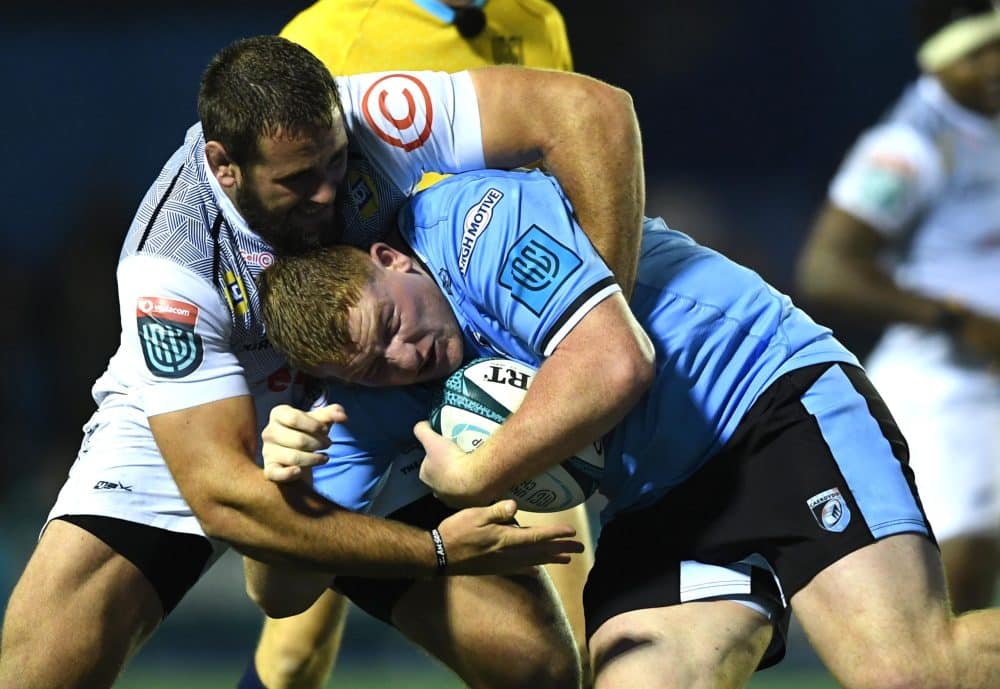
At just 29, Rhys Thomas’s international rugby career was ended by a heart attack, which profoundly affected his sense of identity, his physical health and his mental health.
“It felt like I was losing everything. I was a young man, married with four kids, and when I came out of hospital, I started having panic attacks,” Rhys, now 43, recalls. He has since rebuilt his life around helping others access support after spiralling into a self-destructive mental health crisis.
“I didn’t really understand what mental health meant until that point. If you’d asked me to show empathy for someone with anxiety or a panic disorder just three weeks before my heart attack, I wouldn’t have known it was a ‘thing’. I was one of those guys who would’ve said, ‘Pull yourself together, don’t be a wuss,’” he says.
Bitter experience led Rhys to a first-hand understanding of mental health struggles. In 2013, after his heart condition had deteriorated, Rhys was told he had only a year to live. After months of torturous stress, a left ventricular assist device (LVAD), a mechanical heart pump, was implanted to help keep Rhys alive, but as his physical health stabilised, his mental health deteriorated.
“We are all carrying some degree of suffering, but not everyone has the words to understand and describe what they are going through, even to themselves. This was the case for me. Often, we aren’t taught about the wide spectrum of feelings we experience, or how to navigate them. I now realise the importance of emotional intelligence, and how interconnected our mental health is with our physical health,” Rhys says.
“Many men, in particular, are brought up to believe we have to be stoic, and we’re often not encouraged to share our emotions. The competitive men’s rugby environment reinforced this, in my experience: you just don’t show weakness. Many people are left with an inability to be vulnerable, which is extremely isolating, especially when life’s burdens become too heavy to bear alone.”
Anxiety and sleepless nights plagued Rhys. “When my rugby career ended, it felt as if I didn’t know who I was anymore. Looking back, there was a bit of self-pity and emotional pain I didn’t know how to handle. I went down a dark rabbit hole of alcoholism and self-sabotaging, self-destructive behaviour.”
It all came to a head for Rhys in 2019 when he crashed his car while under the influence. “The events that followed made me realise things were going to need to change. I didn’t realise how bad things really were. Three of my friends from school days arranged an intervention, and my life completely changed from that point on,” he remembers.
Rhys entered the multidisciplinary treatment programme at Netcare Akeso Stepping Stones’ Dual Diagnosis Unit, where mental health treatment is integrated with recovery from substance use.
“At first, I saw myself as a mess in rehab. I felt deep guilt and remorse for the damage I had done to my relationships with my first wife and my children. Then, I learnt the value of being in a space where I wasn’t judged. I met others carrying their own internal struggles, and together we began to offload some of the baggage we’d been holding onto. One of the hardest things for me at first was learning self-compassion. I knew I wanted to become a better man and prove myself as a father.”
Rhys describes how therapy and support groups helped him learn self-realisation and self-compassion, transforming his perspective. “It was an awakening. At the age of 37, at last I had to define, ‘Who am I really?’”
Self-realisation assists in recognising patterns, behaviours and thoughts that may or may not align with a person’s values, while self-compassion teaches us to be kinder to ourselves and less judgemental towards ourselves.
From that point, he began the long journey of rebuilding his life and taking accountability, even though his marriage was irreparably damaged. In 2020, with lockdown in force around the world, Rhys’s former rugby captain, Matt Creel, started an online support group that soon attracted over 1700 members. This led to a realisation of the tremendous need for safe spaces where people can open up about their mental health.
“Support groups helped me feel connected and understand that I could be worthy of love and joy again. Together with Matt, we started a peer support structure for a mental health community, which grew into the Welsh mental health charity Tidy Butt, meaning ‘good friend’,” he says.
To help manage his anxiety, Rhys discovered breathing techniques and cold plunge swimming, and began learning more about how they can help regulate the nervous system and manage emotions. Today, he is a motivational speaker and breathwork practitioner, and a co-founder of Saunahaüs, a cold plunge and sauna club in Sea Point, Cape Town. Drawing on his lived experience, he is a passionate advocate for emotional awareness and social connectedness to support mental health and wellbeing.
After living with a left ventricular assist device for almost 12 years, at last Rhys received a heart transplant in April 2026 at Netcare Christiaan Barnard Memorial Hospital in Cape Town.
“From my lowest point in 2019, I never imagined in a million years that I’d be where I am today. I have a new heart, a new life, new love and a new baby daughter. My children have been my greatest teachers throughout, and it began with professional mental health support and the realisation that whatever we are carrying, we do not have to face it alone,” Rhys says.
“It’s easy to feel disconnected with all our technology and constant information overload, and we can get caught up in our own heads. It’s okay to acknowledge and offload some of that emotional baggage we all carry, to move forward with the lives we want to lead.”
Call Netcare Akeso’s Crisis Line on 0861 435 787, available 24 hours a day, seven days a week, 365 days a year, for support in a psychological crisis. Experienced counsellors are available to listen and offer options for professional support for yourself or a loved one.