


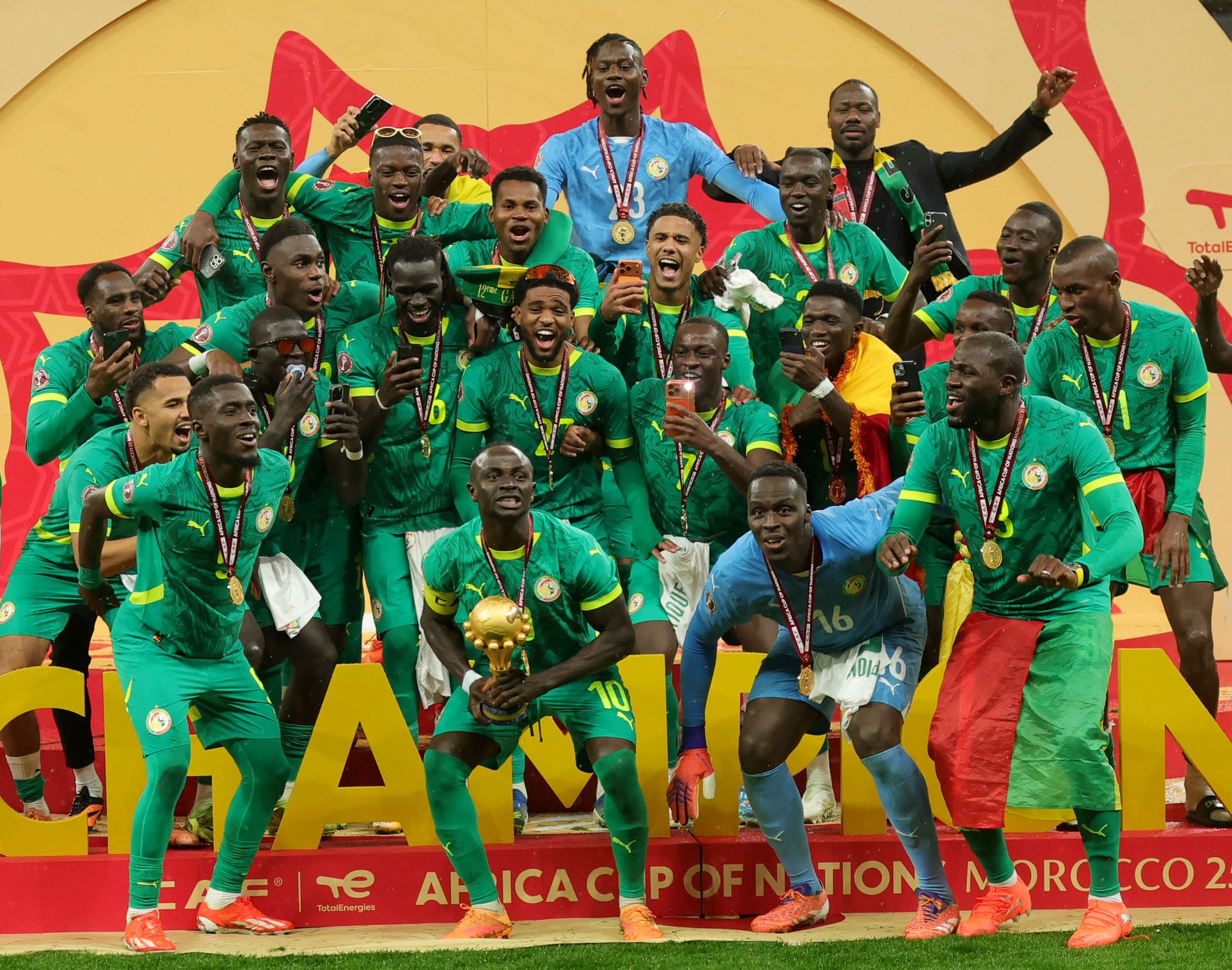
It was all going along swimmingly for African football and its showpiece Cup of Nations tournament in Morocco until minutes from the end of a month-long extravaganza.
But then came a set of farcical events that will forever cloud the tournament with images of eventual winners Senegal walking off in protest at a penalty awarded against them in the final, severely tarnishing the African game.
Here are some talking points after Sunday’s dramatic conclusion of the tournament:
ACTION AGAINST SENEGAL
Senegal might be celebrating their Africa Cup of Nations victory but will be anxiously awaiting possible sanctions for their walk-off during Sunday’s final against Morocco.
Senegal staged a lengthy protest after a penalty awarded in the dying stages of the game to hosts Morocco after a VAR review, walking off the pitch before returning to continue the game.
Morocco squandered the penalty, taking the game into extra time where Senegal scored to win the match 1-0 and emerge victorious for a second time in the last three Cup of Nations editions.
But their actions have been widely condemned, including by both FIFA president Gianni Infantino and the Confederation of African Football and coach Pape Bouna Thiaw, who ordered his players off, and some of those who went off to the change room can expect to face disciplinary charges.
With a trip to the World Cup next for Senegal, they will be concerned that the coach and key players could be suspended for matches at the tournament in Canada, Mexico, and the U.S. in June.
NO AFRO SCEPTICISM FOR 2030
Morocco’s successful hosting of the Cup of Nations means there should be no scepticism about the country’s ability to co-host the World Cup with Portugal and Spain in 2030, even if Sunday’s game was a PR disaster and saw defeat for the home team.
Impressive stadiums, easy transportation links, and a well-established tourism infrastructure ensured the 24-team tournament went off without any major hitch and will assuage any doubters about the World Cup in four years’ time, unlike all the afro-pessimism ahead of South Africa’s hosting of the 2010 finals.
Morocco plans to use six venues in 2030, and five of them were used for the Cup of Nations, providing world-class playing surfaces. The Grande Stade in Tangier, at 75,000, was an impressive facility in the northern coastal city that is less than an hour’s ferry ride from Spain.
Sunday’s final was played at the Stade Mouley Abdellah in the capital Rabat, which has a capacity of 69,500. The attendance for the final was 66,526.
Stadiums in Agadir, Fes, and Marrakech were also more than adequate and will now be renovated over the next years.
But the crowning glory is the proposed 115,000-capacity Stade Hassan II on the outskirts of Casablanca, which Morocco hopes will be chosen to host the 2030 final over Madrid’s Santiago Bernabéu Stadium.
PLAYER OF THE TOURNAMENT
Senegal talisman Sadio Mane emerged with more than just the Player of the Tournament award but also widespread respect for his role in ensuring the match against Morocco was completed.
Mane was the player who persuaded his teammates to return to the pitch after their coach had ordered them off in protest at a penalty awarded against them deep in stoppage time at the end of the match.
Mane said it was his last African championship.
“My last Afcon? Yes, I think I’ve said it, I’ll stop here,” he told reporters.
“I think the next generation is ready, they’ll do the job, I’ll be their 12th man,” the 33-year-old Mane added.
Mane has played in six Cup of Nations, with two winners’ medals in 2021, when he was also named Man of the Tournament, and on Sunday a runner-up in 2019. He scored 11 goals in 29 appearances.
It is likely he will quit international football altogether after Senegal competes in the World Cup in North America in June.