


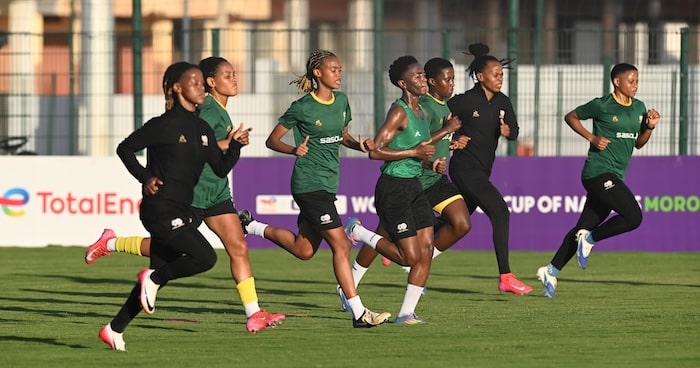
Banyana Banyana take another shot at continental glory with the 2026 Women’s Africa Cup of Nations, writes Firdose Moonda.
The 16th edition of the Women’s Africa Cup of Nations will, for the first time, feature 16 teams in an expansion of the tournament that speaks to the continued growth of the game.
It will be hosted in Morocco for a third successive time, with the hosts hoping to go one better than their previous two finals but face stiff competition from the rest of an improving pack.
Ten-time champions Nigeria, who completed what they called Mission X just nine months ago at WAFCON 2024 (which was played in July 2025 after a clash with the Paris Olympics caused the tournament to be delayed) go in as strong favourites with South Africa’s Banyana Banyana, 2022 champions and a team that has not missed out on a spot in the last nine WAFCONs over two decades, not far behind.
That statistic is important because this year’s WAFCON also serves as a qualification campaign for next year’s World Cup. Africa has four spots at the tournament, which means that the winners of the four WAFCON quarterf inals will book their tickets to Brazil.
If history is a barometer, Banyana Banyana should be confident of their chances of going to a third World Cup and building on their progression from the previous two.
After failing to win a match or even score a goal in 2019, they became the first senior national football side to make it out of the group stage in 2023 and will hope to get the chance to go further in 2027.
To get there, they have to have a successful WAFCON, where they have been drawn in Group B alongside Ivory Coast, Burkina Faso and Tanzania, all of whom are ranked well below South Africa.
Banyana are the continent’s secondbest team, behind Nigeria, and 55th in the FIFA’s rankings.
Ivory Coast, who were included in WAFCON as one of the best four teams who were eliminated during the qualification stage, are 17 places below them at 72nd in the world.
Burkina Faso and Tanzania come in at 118th and 121st respectively, though South Africa will be wary of both.
Burkina Faso climbed 16 spots in the recent update while Tanzania held Banyana to a 1–1 draw in the previous WAFCON.
South Africa finished fourth in that tournament, after topping Group C and beating Senegal on penalties in the quarter-final but lost 2-1 to Nigeria in a fraught semi-final in Casablanca.
That result ended Banyana’s hopes of defending the title they won three years earlier and exposed the gap in quality left by the unavailability of striker Thembi Kgatlana, who was absent for personal reasons.
Mexico-based Kgatlana could be back for this event, which will significantly boost Banyana’s attack, but they will be without Jermaine Seoposenwe, who retired after the last WAFCON.
Seoposenwe cited her own mental health and the poor treatment of women’s players in the country as reasons for walking away.
“I haven’t been happy in the national team for a very long time,” she said on Marawa Sports Worldwide in July 2025.
“It’s definitely the (South African Football) Association (SAFA) and the treatment of us in many instances.
“I tried to wrap my head around it but as a player, it’s difficult, especially being overseas and in an environment where our directors try to make everything as equal as possible.
“Every time we go to a major tournament, we must fight about money and basically everything. Why do we have to fight? Why can’t you plan out for the year? FIFA gives you a calendar of what we are going to do, why can’t you budget for those FIFA dates? Why is it so impossible for you to do well by us?”
SAFA have not covered themselves in glory when it comes to their handling of the women’s game since.
Longserving coach Desiree Ellis was without a contract for over a year from mid-2024 and was not part of the management group that oversaw Banyana’s qualification to WAFCON in a tie against the Democratic Republic of Congo in October last year.
It was only after the team had ensured they would be heading back to Morocco that SAFA and Ellis agreed terms on a new four-year deal, that will see her in charge until 2029.
While that provides some stability, the domestic women’s football league has yet to be professionalised despite continued pleas from players who continue to punch above their weight.
They include the likes of co-captains Refiloe Jane, Amogelang Motau and Lebohang Ramalepe and goalkeeper Andile Dlamini, who are all expected to be part of the squad that will compete at WAFCON 2026.
The winner of the group will go on to play the second placed side in Group A, which features Morocco, Algeria, Senegal and Kenya, while the second-placed side will play the team that tops Group A.