

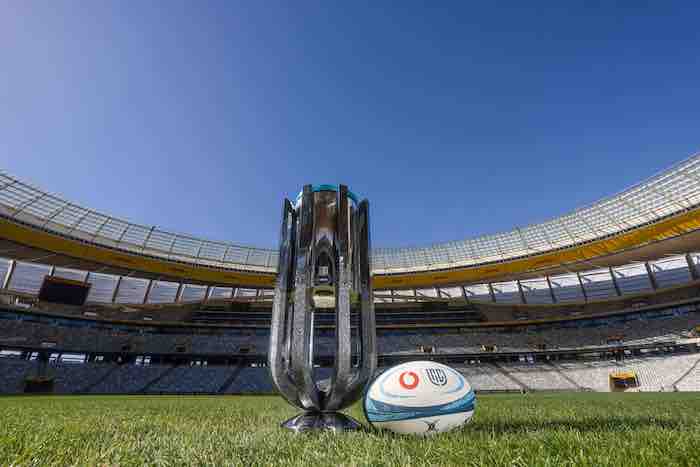
The United Rugby Championship returns this month and will be a crucial season in the build-up to the 2027 Rugby World Cup, writes Jon Cardinelli.
All eyes are on the Springboks 2027 World Cup in Australia.
Having won the last two tournaments, Rassie Erasmus’ charges will be gunning for a hat-trick of titles, and legends such as Siya Kolisi and Eben Etzebeth will be aiming to finish their storied careers on the highest of highs.
In the meantime, it remains to be seen how the respective franchises will manage their Boks over the next 12 months, and how the national resting protocols will influence the performances and results of the Bulls, Lions, Sharks and Stormers across the club season.
Leading South African players have enjoyed few precious opportunities to rest over the past five years, as the club season has bled into the international schedule.
The 2026-27 season should prove especially challenging from a player- welfare point of view, as the club calendar gives way to a six-round Rugby Championship tournament, before Erasmus and company turn their attention to the global showpiece in Australia.
With all that in mind, the Bulls, Lions, Sharks and Stormers may be hard- pressed to improve on their previous showings in the United Rugby Championship – and it may be some time yet before one of these teams ends South Africa’s club title drought.
The Bulls have been South Africa’s most consistent team in the URC, qualifying for four of the past five finals. In each and every decider, poor game management has cost them the title, and that was certainly the case when they lost 36-7 to Leinster in Dublin last term.
The Pretoria-based side took some time to find its feet under new coach Johan Ackermann, but went on to score more points (640) than any other side in the 16-team tournament.
Flyhalf Handré Pollard contributed 129 points to the Bulls’ cause, while scrumhalf Embrose Papier (12) was the competition’s joint top-scorer, along with Stormers No.8 Evan Roos.
Bulls fans may expect their team to go one better this season. Whether they can reach the same heights without Springboks of the quality of Kurt-Lee Arendse, Ruan Nortjé and Wilco Louw remains to be seen.
The Stormers started the 2025-26 season well, winning 10 matches in a row across both competitions, before losing momentum at the back end of the campaign and travelling to Dublin for the penultimate clash.
Coach John Dobson is determined to build a team that can win the URC and the Champions Cup – possibly by 2029 – and has backed up the talk by making several high-profile signings in recent months. Kolisi and Louw have returned to the franchise, while Cheslin Kolbe is back in Cape Town after a long stint in France and Japan.
The Stormers will begin the season with two – and in some cases three – excellent options in each position.
Cobus Reinach, Sacha Feinberg- Mngomezulu, Damian Willemse and Kolbe will headline an explosive backline – although Bok resting protocols may ensure that some of the stars are managed across a club schedule that spans 10 months.
The Lions made history last season when they qualified for the URC playoffs for the first time. While they do not have the same resources as the other three franchises, they should be pushing for another top-eight finish in 2026-27.
Coach Cash van Rooyen has signed Bok prop Boan Venter and forgotten No.8 Sikhumbuzo Notshe, and will look to harness a clutch of Junior Boks who recently defended their title at the World. Rugby Junior World Championship in Georgia. The powerful No.12 Ethan Adams is certainly one to watch.
The Sharks come into this URC campaign with everything to prove, having finished 10th in the standings last term. Despite their status as one of the richest teams, they have failed to deliver a trophy of significance over the past five years, and are yet to progress to a URC final.
The Sharks have parted ways with coach John Plumtree, and JP Pietersen, who took charge in the second half of last season’s campaign, will have the opportunity to change the narrative in the coming months. High-profile players such as Kolisi, Aphelele Fassi, Grant Williams and Marvin Orie have moved on, but Bok powerhouse Thomas du Toit and two former internationals in Ivan van Zyl and Stephan Lewies have joined the franchise.
The Sharks pack looks set to dominate, but the questions regarding their best halfback pairing persist. Pietersen may give further opportunities to Junior Bok stars such as Vusi Moyo – who made his Test debut for the senior national side this past July – and Zekhethelo Siyaya, while André “the Giant” Esterhuizen should continue to play a key leadership role from the No.12 position.
Ackermann, Dobson, Van Rooyen and Pietersen will have other fixtures to consider over the course of a long and taxing season.
The South African teams have been criticised for their inconsistent performances in the Champions Cup, but given all the demands at club and national level in 2026-27, they may struggle to shatter the glass ceiling and progress to the semi-finals.
The Lions will make their Champions Cup debut this season, and may be hard-pressed to compete against the best teams from England and France – after delivering an underwhelming performance in last term’s Challenge Cup, where they failed to reach the playoffs.
The Sharks will be desperate to regain their Champions Cup status this season, but may be caught in two minds.
Pietersen’s side has to finish in the top eight of the URC (at least) to qualify for the next edition of the Champions Cup.
Alternatively, they will earn a place at Europe’s top table if they win the Challenge Cup title – as they did back in 2024.
Overall, South African fans will be hoping for a more consistent showing across the board that results in two or more of the local teams progressing to the URC semi-finals, and possibly a decider on home soil.