


The new European club season is almost upon us and while much can still change between now and kick-off, what do history and the statistics say about potential winners in 2026-27? By Nick Said.
The new European football season is still weeks away and much remains uncertain.
The transfer market has not settled yet, coaching changes continue and clubs will spend the time after the 2026 World Cup trying to reshape squads and assess players whose reputations have risen or fallen in North America.
That makes long-range predictions difficult. Yet while personnel changes are uncertain, we can look to history for some clues.
Across Europe’s five major leagues, title races are often remarkably similar and the same trends repeat themselves over time. So what should we expect this time round?
ENGLISH PREMIER LEAGUE
England continues to offer the most competitive title race among Europe’s leading leagues, but recent history suggests there is a clear benchmark for success.
Premier League champions have averaged 89 points over the last decade and eight of the last 10 winners have earned at least 86.
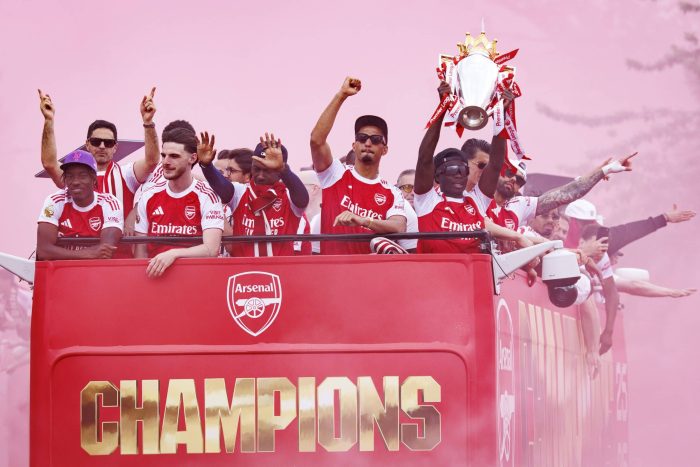
Arsenal ended a 22-year wait for the title in 2025/26, but repeating that achievement may prove more difficult.
Back-to-back champions are comparatively rare in England. Since the formation of the Premier League in 1992, only four clubs have defended the title – Manchester United, Arsenal, Chelsea and Manchester City.
City’s dominance has shaped the modern era. Before Arsenal’s recent success, they won six successive league crowns and eight of the previous nine.
Defending champions generally remain competitive. Since 2010, only three title holders have finished outside the top two the following season.
Manchester City are again likely to challenge despite the departure of Pep Guardiola after a decade in charge.
Liverpool are expected to improve after an underwhelming campaign, while Manchester United’s progress under Michael Carrick suggests they may enter the conversation.
Chelsea remain harder to assess. Their squad depth suggests potential, but instability has undermined them in recent seasons.
They are, for all intents and purposes, a basket case. Another trend concerns promoted clubs. Of the 15 promoted sides over the last five Premier League seasons, 11 were relegated immediately, highlighting the increasing gap between divisions.
Coventry City, Ipswich Town and Hull City will all battle to stay up this season.
SPANISH LALIGA
Spain’s title race has been dominated by familiar names over the last two decades.
Barcelona, Real Madrid and Atlético Madrid are the only clubs to have won LaLiga since 2005, with Barca and Real accounting for 18 of the last 21 championships.
Barcelona begin 2026/27 as defending champions, though history suggests Real Madrid rarely stay down for long.
And with the returning José Mourinho at the helm, there is sure to be a shake-up.
Since 2000, Real have failed to reclaim the title within two seasons of losing it only twice.
Their decision to bring Mourinho back to the club reflects that urgency, though questions remain over whether he can rediscover the consistency that defined earlier periods of his career.
Is he ‘yesterday’s man’, rather than a coach for the present? The average LaLiga-winning points total over the last decade stands at 87, underlining the importance of consistency against lower-ranked opposition.
Barca have also tended to respond well to success, defending the title in five of the last eight opportunities when entering a season as champions.
GERMAN BUNDESLIGA
No league in Europe has been shaped by one club to the extent of Bayern Munich in Germany.
Bayern have won 18 of the last 22 Bundesliga titles and secured an 11-season streak between 2013 and 2023.
The average Bundesliga champion over the last decade collected around 80 points, though Bayern have frequently moved beyond that mark with ease.
Their advantage is reflected in attack as well. Bundesliga champions have averaged 84 goals a season in the last 10 years, while Bayern regularly surpass 90 and occasionally exceed 100.
Last year they scored a massive 122 in 34 games, just a staggering number.
Borussia Dortmund, Bayer Leverkusen and RB Leipzig have mounted challenges at various stages, but sustaining pressure across a full season has proved difficult.
Harry Kane remains central to Bayern’s attack. Despite operating in deeper positions at times last season, he again produced elite scoring numbers.
The broader trend suggests Bayern remain the side others must catch rather than merely compete with.
ITALIAN SERIE A
Along with the Premier League, Italy offers greater competitive variation than many of Europe’s leading leagues.
Four clubs have shared the last 10 Serie A titles – Juventus (four), Inter Milan (three), Napoli (two) and AC Milan (one).
Inter enter the campaign as defending champions, but retaining the Scudetto has historically been difficult.
Juventus are the only side to defend a Serie A crown in the last decade.
Serie A champions have averaged around 85 points over the last 10 seasons, often with tighter margins than elsewhere in Europe.
Napoli face uncertainty after the departure of Antonio Conte, while Juventus and Milan are rebuilding after disappointing campaigns.
Roma and Como appear to be moving in the right direction but may still lack the depth required for a sustained title challenge.
FRENCH LIGUE 1
France presents perhaps the clearest picture of who will be champions because they have serial winners who can dwarf the rest of the league in spending power.
Paris Saint-Germain have won 11 of the last 13 Ligue 1 titles and have not finished outside the top two since 2011.
Only Monaco in 2016/17 and Lille in 2020/21 interrupted Paris Saint-Germain’s dominance during that period.
The average Ligue 1 champion over the last decade earned about 83 points, though Paris Saint-Germain frequently exceed that figure comfortably.
Financial disparity remains decisive. Paris Saint-Germain’s spending power continues to dwarf domestic rivals, leaving challengers reliant on inconsistency from Paris rather than expecting to outperform them over a season. Lens pushed them closely last year but still finished six points adrift.
THE WORLD CUP FACTOR
The season following a World Cup often brings disruption and can mean there are surprises in the title races, not so much the winner but who challenges.
Players return late, injuries increase and clubs reassess recruitment plans after standout performances on the global stage.
Unexpected contenders can emerge, while established sides occasionally struggle for rhythm That uncertainty will shape the opening months of the 2026/27 season.
But while transfers and managerial appointments may alter expectations, historical patterns continue to offer the best clues and the champions in each league will come from those who can hit the average number of points required and go a little beyond it.